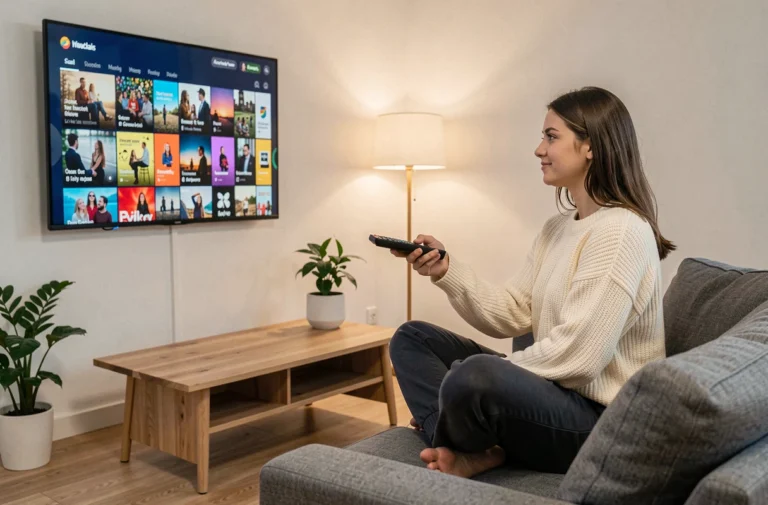
The main friction in households no longer comes from sharing tasks or meal planning. It comes from the fragmentation of attention. Notifications, screens checked between sentences, the mental load running in the background without ever being articulated: this is what erodes the quality of shared family moments.
Digital interruptions and family life: the real source of tension
A survey reported by ConsumerAffairs in September 2026 shows that a large majority of parents report disagreements or conflicts related to screen time at least every week. The problem is not the technology itself. It’s the way it slips into the cracks of daily life without anyone consciously deciding it.
We observe that conflict increases when rules are set reactively, in response to a perceived excess. Banning or restricting a screen when the child is using it generates direct opposition. The reverse strategy works better: create a shared activity that makes the screen less appealing rather than demonizing it.
The same survey recommends a family micro-ritual after dinner, in the form of a shared activity lasting ten to twenty minutes. A card game, a collective drawing, a dessert preparation. The goal is not to fill time, but to offer a concrete alternative that does not rely on the individual will of each household member. Among Blog 4 Web’s family tips, this approach of substitution rather than restriction regularly comes up as an underestimated lever.

Invisible mental load: identifying what fragments presence
The mental load is not limited to the shopping list or medical appointments. It includes everything that occupies a parent’s attention without being visible to other household members: anticipating a conflict between siblings, remembering a school form, calculating whether the week’s schedule holds.
The invisible mental load prevents being present even when physically there. A parent having dinner with their children while mentally planning the next day is not available. The children perceive this, even without articulating it.
Externalizing the load onto a shared support
We recommend systematically transferring cognitive tasks to a consultable support for all. A whiteboard in the kitchen, a shared list app, a displayed weekly schedule. The support matters less than the principle: what is written no longer needs to be kept in mind.
The direct benefit is not organization. It is the freeing up of mental space for the relationship. A parent who knows the schedule is written down somewhere can afford to let go during the time spent with their children.
Naming the load to distribute it
The mental load remains invisible until it is verbalized. Asking once a week the question “what’s on your mind right now?” among adults in the household makes explicit what consumes energy. Without this verbalization, the distribution remains unbalanced by default.
Family routine: structuring without rigidifying daily life
A routine is only valuable if it reduces the number of decisions to be made. Each micro-decision (who prepares what, what time to leave, who accompanies whom) consumes cognitive energy. Effective routines eliminate recurring negotiations.
On the other hand, a routine that is too rigid produces the opposite effect: it generates stress when an unforeseen event disrupts it. The balance lies in distinguishing between fixed anchor points and flexible zones.
- Fixed anchor points: children’s bedtime, main meal time, designated homework slot. These elements are not negotiated daily.
- Flexible zones: choice of weekend activity, dinner menu, organization of free time. These elements adapt to the household’s available energy.
- Transition signal: a gesture or moment that marks the shift from one phase to another (putting away the backpack upon arrival, washing hands before a meal). These signals reduce repetitive verbal reminders that exhaust parents and children.

Quality moments with family: duration matters less than regularity
We often observe a confusion between “spending time together” and “being available together.” Watching a movie as a family for two hours with everyone on their phone does not have the same effect as fifteen minutes of board game with everyone’s attention.
The regularity of a short shared moment builds more connection than an exceptional event. A trip to the amusement park once a year does not compensate for the absence of daily rituals. Research reported by Phys.org in August 2026 confirms that intensive social media use by parents affects the perceived quality of family relationships, not by the total time spent online, but by the fragmentation it causes in interactions.
Protecting screen-free slots
The most valuable slot to protect is mealtime. No need for complex rules: phones stay in another room while we eat. This simple constraint produces measurable effects on the quality of exchanges because it removes the temptation to check a notification.
The second slot to sanctify is bedtime. The attentive presence of a parent for ten minutes when the child is falling asleep has more impact on the feeling of security than any structured educational activity.
Daily family harmony does not rely on a perfect organization system. It depends on each adult’s ability in the household to protect periods of undivided attention, to verbalize what usually remains implicit, and to accept that the regularity of small gestures is worth more than the perfection of a grand plan.